
AI for Estate Agents: How UK Agencies Can Qualify Leads and Book More Viewings Without Hiring More Admin
Most UK estate agencies are not losing instructions because they are bad at property. They are losing instructions because response speed, follow-up consistency, and admin capacity break down under volume.
A valuation request comes in at 8:42pm. A first-time buyer asks three questions at 7:10am. A landlord wants to book a viewing while negotiators are in appointments all day. If those enquiries wait hours, competitors get there first.
This is the same core problem we see across many small businesses: demand is there, but communication bottlenecks choke growth. We covered this broader pattern in How to Automate Your Small Business in 2026, and estate agencies are one of the clearest examples.
The good news: this is exactly the type of work AI can handle well.
In this guide, we’ll break down where UK agencies lose leads, how AI can qualify buyer and seller enquiries, how to automate viewing workflows without sounding robotic, and what implementation looks like in practice.
Why Estate Agencies Lose Leads (Even When Demand Is Strong)
On paper, most agencies already do the right things:
- List properties quickly
- Invest in portals and digital marketing
- Train teams on negotiation and customer care
In practice, the operational reality is messier:
- Leads arrive outside office hours
- Teams are interrupted constantly
- Follow-up quality drops at busy times
- Qualification is inconsistent between staff members
That inconsistency is expensive.
Industry data consistently shows that speed to lead and number of follow-ups heavily influence conversion outcomes. The exact percentages vary by source, but the trend is always the same: agencies that respond quickly and consistently win more business than agencies that respond eventually. For broader response-time evidence, see this analysis on speed to lead performance.
What AI Should Handle in an Estate Agency (and What It Shouldn’t)
Before tools, clarity. AI works best when the job is repeatable, high-frequency, and process-driven.
AI is strong at:
- Instant first response to enquiries
- Asking structured qualification questions
- Routing leads by intent (buy/sell/let/rent)
- Booking viewings into predefined slots
- Sending reminders and confirmations
- Chasing missing details
AI is weaker at:
- High-stakes negotiation nuance
- Emotion-heavy complaint handling
- Complex chain management conversations
- Sensitive escalation decisions
A useful mental model is the same one we outlined in AI Workers vs Virtual Assistants: use AI for consistent frontline volume, and humans for judgment-heavy exceptions.
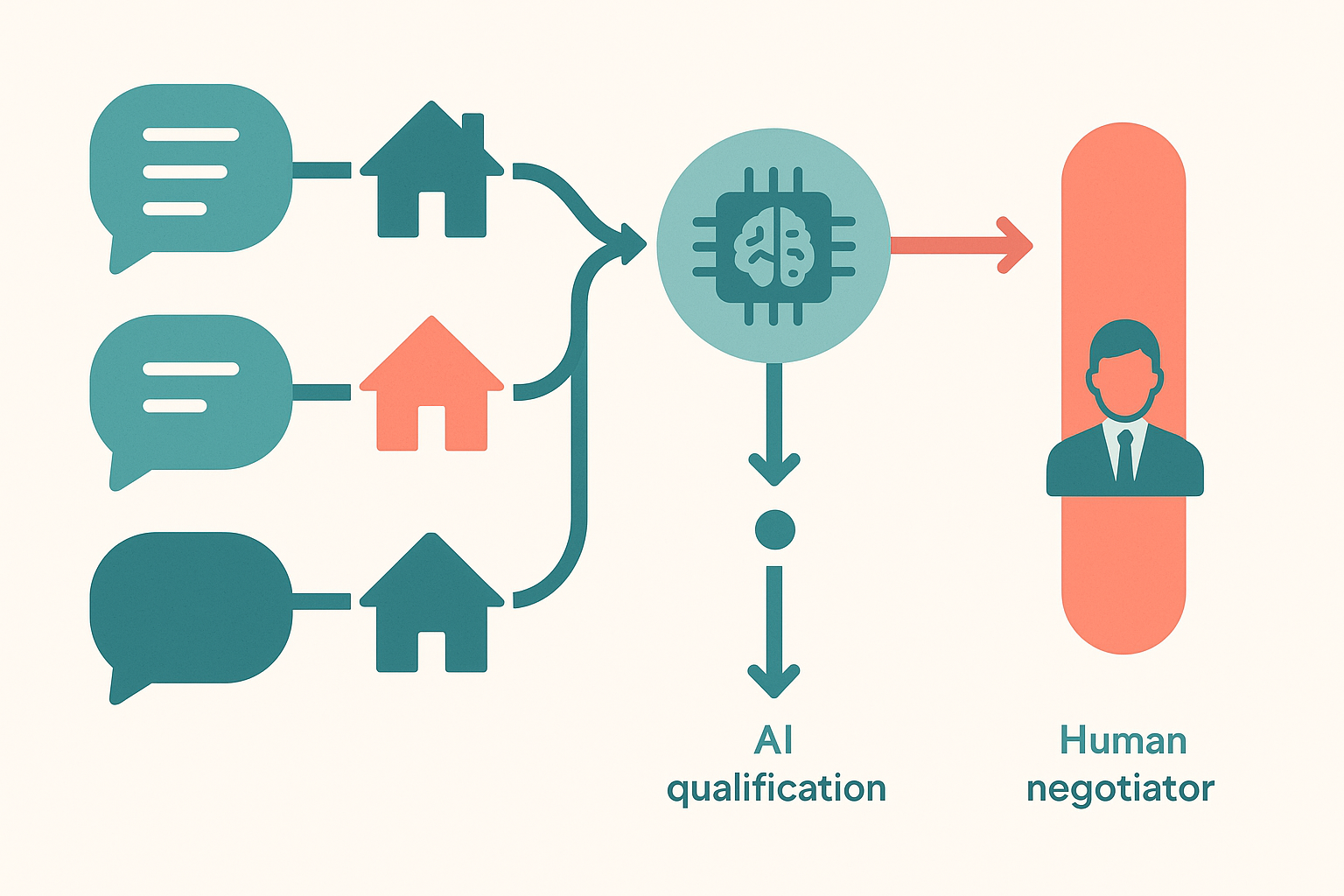
The Highest-ROI Workflow: Lead Qualification + Viewing Booking
If you only automate one thing first, make it this.
Why? Because this workflow sits closest to revenue.
When a lead arrives, your ideal process is:
- Acknowledge immediately
- Gather key information
- Decide lead quality and intent
- Offer next step (valuation call, viewing slot, callback)
- Confirm and remind
Most agencies do this manually across calls, WhatsApp messages, emails, and portal messages. That creates delay and inconsistency.
AI can run this sequence in seconds, 24/7, with consistent standards.
Example Qualification Questions by Intent
Buyer lead
- Are you a first-time buyer, mover, or investor?
- Have you arranged a mortgage in principle?
- What budget range are you targeting?
- Which postcodes or commute routes matter most?
- How soon are you looking to move?
Seller lead
- Is this a valuation for sale now or planning ahead?
- Property type and postcode?
- Is the property currently occupied?
- Have you instructed another agent?
- Preferred times for valuation appointment?
Landlord lead
- Single let, HMO, or portfolio?
- Fully managed or let-only preference?
- Current tenancy status?
- Compliance status (EPC, EICR, gas safety)?
- Target rental timeline?
These questions are not “AI magic.” They are your existing best-practice scripts, delivered instantly and consistently.
A Practical Scoring Model for Lead Prioritisation
Not every lead deserves equal urgency. A simple weighted score helps teams focus where conversion probability is highest.
| Criterion | Example signal | Score |
|---|---|---|
| Intent clarity | “Need to view this weekend” | +20 |
| Timeframe | Move/let/sell within 4 weeks | +20 |
| Financial readiness | Mortgage in principle / landlord docs ready | +20 |
| Property fit | Budget/location aligns with stock | +15 |
| Engagement | Responds quickly to qualification prompts | +15 |
| Contact quality | Valid phone + email provided | +10 |
Total: 100 points
Suggested routing:
- 75–100: High priority, immediate negotiator callback + urgent viewing options
- 50–74: Standard workflow, book within normal SLAs
- 0–49: Nurture sequence + periodic check-in
This gives your team a shared operating language and prevents “who shouted loudest” queue management.
The Operational Advantage: Response Consistency at Scale
One of the biggest hidden costs in agency operations is variability. Two negotiators can handle the same lead very differently depending on workload and time of day.
AI gives you:
- Standardised first touch on every enquiry
- No dropped conversations at shift boundaries
- Clean data capture for CRM updates
- Reliable SLA adherence for callbacks and reminders
This is similar to what we discussed in How to Handle Customer Enquiries 24/7 Without Hiring Night Staff: availability itself becomes a competitive differentiator.
Compliance and Trust: Keep It Practical, Not Paranoid
UK estate agencies handle personal data daily, so any automation must be GDPR-aware.
You do not need to avoid AI to stay compliant. You do need clear process controls.
At minimum:
- Use a provider with a proper data processing agreement (DPA)
- Define what personal data AI can access
- Keep retention periods clear
- Ensure escalation paths for sensitive requests
- Update your privacy notice accordingly
For a full plain-English breakdown, see Is AI Safe for My Small Business? Data Security and GDPR Explained, plus official ICO guidance on contracts and data processors.
What a “Good” AI Response Actually Sounds Like
Poor automation sounds robotic and damages trust. Good automation sounds clear, helpful, and specific.
Weak response
“Thanks for your message. We will contact you shortly.”
Strong response
“Thanks for your enquiry about the 3-bed in SE13. We can help with that. Are you looking to view this week or next week? If you share your preferred days, I can offer available viewing slots right away.”
The second version moves the conversation forward. That’s the point.
30-Day Implementation Plan for a UK Agency
You don’t need a six-month transformation project. Most agencies can launch a working frontline AI workflow within 30 days.
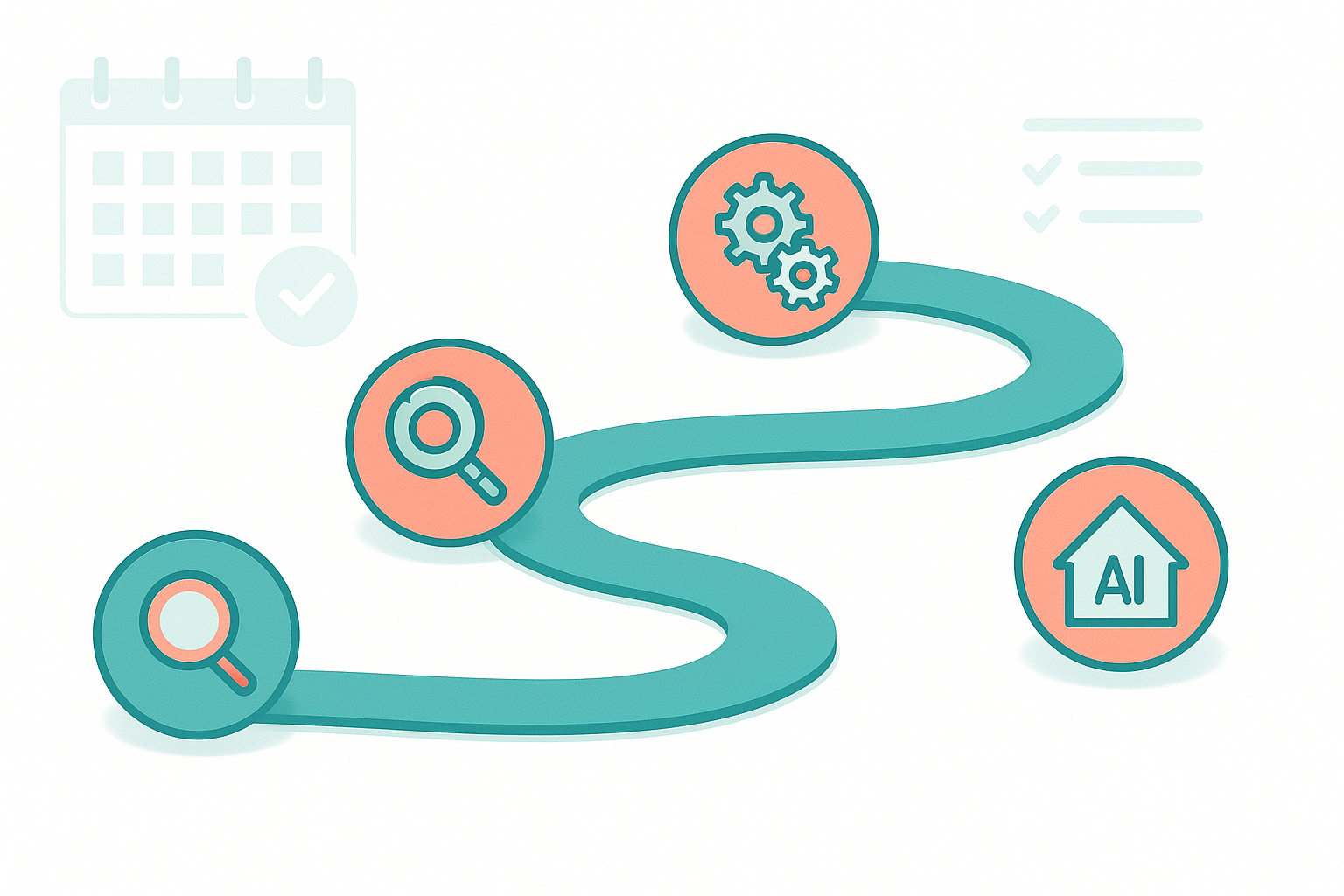
Week 1: Process Mapping
- Audit lead sources (portal, website, social, phone, WhatsApp)
- Define enquiry categories and qualification questions
- Set escalation rules (when to hand to human)
- Align team on response tone and SLA targets
Week 2: Build + Integrate
- Configure AI response flows by lead type
- Connect to CRM and calendar where possible
- Create fallback rules for ambiguous enquiries
- Draft standard templates for confirmations/reminders
Week 3: Supervised Pilot
- Run AI in monitored mode
- Review missed intents and awkward replies daily
- Adjust qualification wording and routing thresholds
- Collect baseline metrics against previous manual period
Week 4: Controlled Go-Live
- Shift routine front-door enquiries to AI by default
- Keep clear human escalation channels visible
- Track KPIs weekly and refine continuously
- Document edge cases for future training
KPIs That Actually Matter (Not Vanity Metrics)
Many teams over-focus on “messages handled.” Useful, but incomplete.
Track outcomes tied to revenue and service quality.
| KPI | Why it matters | Typical improvement target (first 60 days) |
|---|---|---|
| First response time | Core driver of conversion odds | -60% to -90% |
| Lead-to-viewing rate | Measures qualification effectiveness | +15% to +35% |
| Viewing no-show rate | Measures reminder/confirmation quality | -10% to -25% |
| Valuation booking rate | Seller pipeline health | +10% to +25% |
| Admin hours per negotiator | Capacity recovered for billable work | -4 to -8 hrs/week |
If you’re cost-planning, pair these gains with budgeting from How Much Does Business Automation Really Cost in 2026?.
Common Estate Agency Objections (and Reality)
“Our clients want human contact.”
Correct. That’s why the right model is AI first response + human expertise at the right moment. Clients usually want speed and clarity first, then human judgment when needed.
“AI will answer things incorrectly.”
Only if configured poorly or left ungoverned. With scoped prompts, escalation rules, and weekly QA, error rates become manageable and visible.
“Our market is too nuanced.”
Market nuance is exactly why your negotiators should spend less time copying appointment details and more time doing valuation strategy, negotiation, and relationship building.
“We’re too busy to implement this.”
That is usually the strongest reason to implement. If communication load is already bottlenecking growth, waiting increases opportunity cost.
Suggested Internal Team SOP (Simple Version)
To keep adoption clean, document one-page SOPs.
SOP 1: Enquiry intake
- AI handles first response and qualification
- If high intent score (75+), notify negotiator immediately
- If uncertain intent, escalate after second message
SOP 2: Viewing bookings
- AI proposes slots from approved availability windows
- AI confirms booking + sends reminder 24h before
- If reschedule requested twice, handover to human
SOP 3: Seller valuations
- AI collects property basics and motivation timeline
- AI offers valuation slot options
- Human confirms prep advice before appointment
These SOPs reduce team friction and make performance measurable.
Where This Fits in a Broader Agency Growth Strategy
AI lead qualification is not a silver bullet. It is an operational multiplier.
For strongest results, combine it with:
- Clear local positioning pages
- Faster listing turnaround
- Better pre-viewing communication
- Strong post-viewing follow-up discipline
The pattern is the same as in 10 Signs Your Small Business Is Ready for an AI Worker: when repetitive communication volume is high, automation gives immediate capacity back.
A Realistic “Before vs After” Snapshot
Below is what many agencies experience after a controlled rollout.

| Area | Before | After AI + human escalation |
|---|---|---|
| New enquiry response | 2–6 hours (office dependent) | Under 2 minutes, 24/7 |
| Qualification consistency | Staff dependent | Standardised by workflow |
| Viewing scheduling | Manual back-and-forth | Automated slot offering + reminders |
| Missed/forgotten follow-up | Common at peak times | Reduced via automated sequences |
| Negotiator focus | Admin-heavy | Higher-value sales and vendor work |
Even moderate improvements here can materially impact monthly revenue.
Final Takeaway
If your agency is getting enquiries but struggling to convert them consistently, the issue is rarely lead generation alone. It’s usually lead handling speed and quality.
AI gives you a practical way to:
- Respond instantly
- Qualify consistently
- Book more viewings
- Reduce admin drag
- Free negotiators for high-value work
Start with one workflow. Measure outcomes. Expand from proof, not hype.
That approach keeps risk low and ROI visible.
Frequently Asked Questions
Is AI for estate agents only useful for large multi-branch firms?
No. Smaller agencies often see faster gains because owners and negotiators are personally stretched. When a small team automates first response and qualification, recovered hours are immediately redeployed to valuations, viewings, and deal progression.
Will AI replace negotiators in a UK estate agency?
Not in the way most people fear. AI is strongest at repeatable communication and scheduling. Negotiators remain essential for valuation strategy, objection handling, negotiation, and trust-building with vendors and buyers.
What is the first workflow a UK agency should automate?
For most teams, start with enquiry triage + viewing booking. It’s high-volume, close to revenue, and easy to measure through response time, lead-to-viewing rates, and fewer missed follow-ups.
How do we keep AI responses from sounding robotic?
Use real conversation examples from your current team as training references. Keep message tone natural, concise, and context-specific. Add escalation prompts early for unusual or emotional scenarios.
Is it GDPR-compliant to use AI for lead qualification?
It can be, provided your setup is compliant. You need lawful processing, a proper DPA with your provider, clear retention and access controls, and transparent privacy information for customers. The ICO guidance should be your baseline reference.
Should we use photorealistic images or infographics in estate agency posts?
Use whatever serves clarity best. For process-heavy content like this, infographic-style visuals often perform better because they explain workflows and outcomes quickly. Photoreal images can work well for case-study style posts.
How many follow-ups should AI send before a human steps in?
A practical default is 2–3 structured attempts over a short window. If no response or if ambiguity remains, route to a negotiator for manual judgement. Avoid over-automation that feels pushy.
Which metrics prove AI is working in an estate agency?
Track first response time, lead-to-viewing conversion, viewing no-show rate, valuation booking rate, and admin hours saved per negotiator. These metrics tie directly to pipeline quality and revenue potential.

TheyWork Team
TheyWork gives small UK businesses an AI-powered worker that finds leads, writes content, responds to reviews, and handles admin — so you can focus on growing.
Ready to try an AI Worker?
Get your own AI worker that finds leads, writes content, and handles admin. Start free for 7 days.
Get startedMore from the blog

Is AI Safe for My Small Business? Data Security and GDPR Explained
A straightforward guide to AI safety for UK small businesses. Understand data security, GDPR compliance, and how to use AI tools confidently without putting your business at risk.

10 Signs Your Small Business Is Ready for an AI Worker
Not sure if AI is right for your business? Here are 10 clear signs that your small business is ready for an AI Worker—and would benefit from implementing one today.